 Skip to content


Press
Is Bulgaria a Sinking Ship? – Zavrashtane.com
Is Bulgaria a Sinking Ship?
Mitko and Jen, Season 2, Episode 1
Energized. Cheerful. Ready for adventure. We start with the short answer from Mitko, an entrepreneur who returned to Bulgaria.
Is Bulgaria a Sinking Ship?
Mitko: The short answer is: “In our opinion, no!”
Mitko is married to the American Jen. The two are business partners at Bulgarian Honey Co. Jen discovers a closeness between people unlike anywhere else — right here in Bulgaria. (Read the full conversation here with a Bulgarian translation or listen to the podcast audio in Bulgarian and English.)
I met Mitko and Jen after the premiere of my film THERE in San Francisco. Part of me secretly hopes that the film at least a little reinforced their intention to return. The film can be watched freely here.
In the summer of 2020, Mitko wrote to me that he and Jen had returned. That letter of his is where our friendship began! Mitko and Jen inspire me constantly. I believe you will be deeply inspired as well!
Bogdan Darev
People earn more money in the States. You go there and you realize: “Yes, you earn a lot of money, but you also have no pension plan, things are expensive, and people go into debt in a consumer culture.” And then you realize: “This isn’t what I thought it would be. I miss the closeness with people.” – Jen
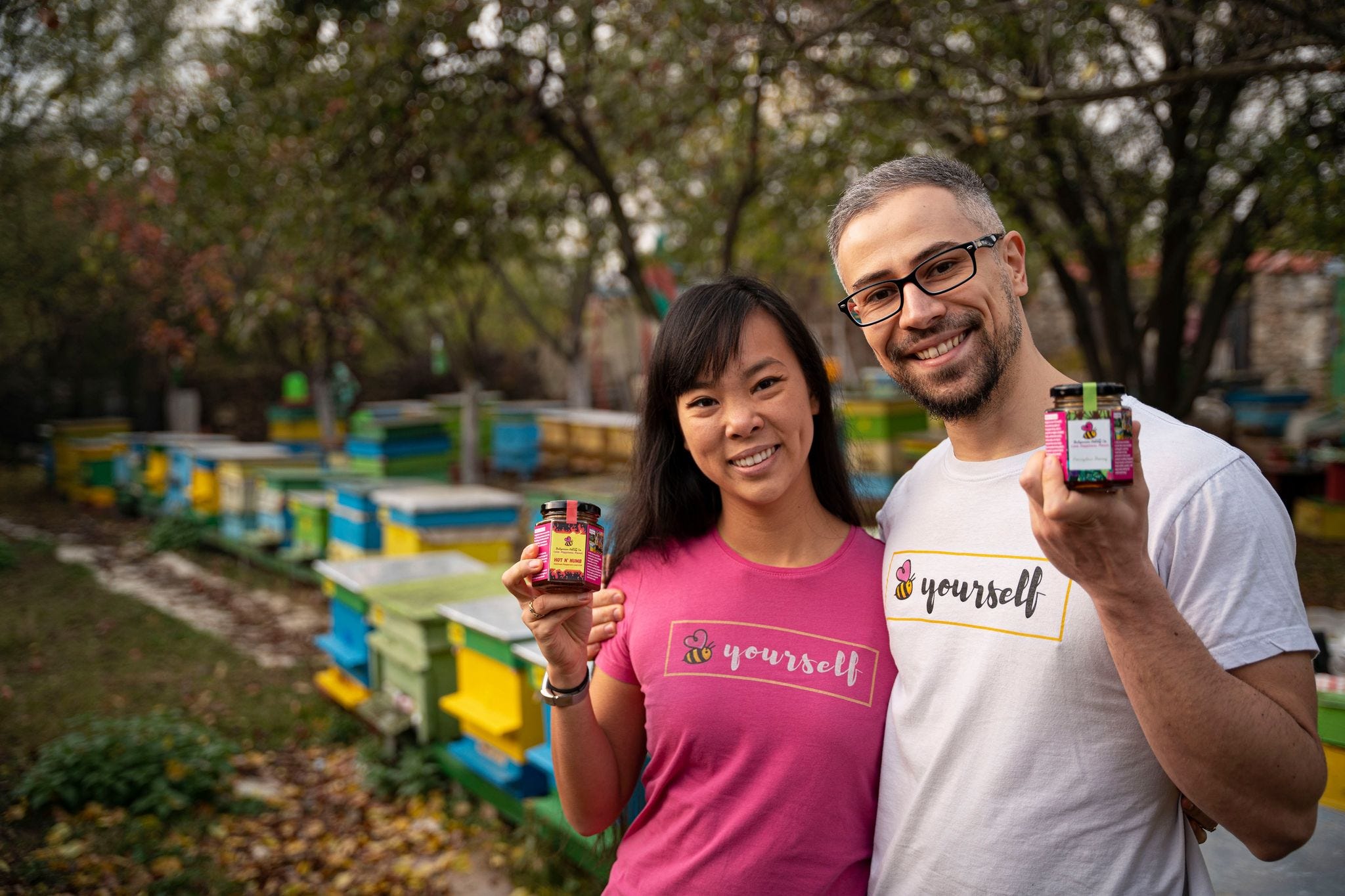
Mitko and Jen
All interviews are minimally edited for clarity.
Jen (in Bulgarian): I’m Jen and I was born in the USA. We went to Bulgaria two years ago and I love this country very much. Before I was a beekeeper, I worked in real estate investments in the States. What else? (to Mitko)
Mitko: I think that’s enough.
J: Okay.
M: I’m Mitko. My artistic nickname is “The Allergic Beekeeper,” because I work with bees and I’m allergic to them. I lived in the San Francisco Bay Area for roughly seven years. Two years ago, as Jen mentioned, we decided to move to Bulgaria — for me it was a return, and for her it was a new beginning.
Since then we started our business, which ties into the story of “The Most Valuable Wedding Gift.” In my family, the tradition of beekeeping began more than 100 years ago — 101 years, to be exact — when at my great-grandmother’s wedding the young couple received a beehive as a gift. One beehive, not an entire apiary, just one bee colony, one hive. That’s where my family began keeping bees, and this livelihood was passed down from generation to generation, all the way to our own wedding, when my parents gave us not one hive, but the entire apiary.
From there, many ideas came to us about how we could contribute to Bulgaria’s development and share Bulgaria with the world — through our exceptional Bulgarian honey. That idea, in essence, is what set the beginning of our return.
ON ORDINARY LIFE
J (in Bulgarian): Yes, I really love that everyone is so close — the shops, the neighbors. Everything and everyone feels very close and life is more… I don’t know, more full. It feels more fulfilled, because I feel much more connected here. Before, in the USA my life was only work. I was always very busy and didn’t have much time for fun, for hobbies, for friends. But here in Bulgaria it’s much easier for me not only to work, but to combine different interests.
M: Well, ordinary life for me was perhaps when I was a child. That kind of life I can associate with childhood — when there are somehow no responsibilities, everything is lighter and doesn’t carry so much assigned meaning. Whereas in the extraordinary life, even from my teenage years, things and events began to happen that I was actually creating around me. When different opportunities appeared, I always… didn’t hesitate. When I see an opportunity, I jump into it and take advantage of it.
One such opportunity was even my departure to the States. I won a green card in the lottery. And my first thought was what would I do there — I didn’t know anyone. I had some plans, of course, where I would go… At that point I was just finishing my bachelor’s degree and planning where I would pursue my master’s. But generally I decided to leave all plans and previous ideas aside and simply take advantage of the opportunity. And I have no regrets at all. So perhaps that was one of the first key steps I took, one that turned my life around and opened me up to many things.
The lifestyle in the States gave me many valuable perspectives and very important professional experience. I had actually graduated in Computer Systems and Technology as a programmer in Bulgaria. And there I found myself in Silicon Valley — there was no better place for me than that. And that experience now allows me to grow a business and create jobs in Bulgaria, to create opportunities for other people.
BD: Which is key, and that leads me to a thought. I have a friend here who is from El Salvador. She and her family want to return to El Salvador. We were talking and she said:
“We are not returning to El Salvador to live there — we are returning to transform the country.”
And my feeling is that this is exactly what we are doing — those of us who have chosen, are choosing, and will yet choose to return to Bulgaria. I often hear that we as immigrants should return and simply continue life as before. But if we return with that mindset, we are essentially setting ourselves up to be deeply disappointed.
I hear from you that you returned with the intention of transforming the way business is done in Bulgaria. We’ve had conversations and you’ve told me: “Bogdan, it takes me ten times longer to get through all the bureaucracy,” but you continue to work according to the laws, according to the human relationships in Bulgaria. Can you tell us a little about your experience doing business in Bulgaria?
ON DOING BUSINESS IN BULGARIA
M: Definitely. From the standpoint of administrative shortcomings and bureaucracy — those are among the downsides. But the upside is that there is an enormous field for development. New concepts, technologies, and ways of doing business are now beginning to emerge in Bulgaria. And they come, generally speaking, from people who have traveled, seen how things happen around the world, and have seen an opportunity to bring what they’ve learned back to Bulgaria. That is largely what we are doing as well.
Overall, there is a wave of development here, in my opinion, of which we are a part. And in many cases, because everything is so small and local, we personally know — after just two years — almost every business owner in Plovdiv, where we live. In such an environment, collaborations happen very easily, whereas at the scale of the United States it would be hard to say you know some percentage of all business owners in the country, or even in a single state. Anything else, Jen, from a business-in-Bulgaria perspective?
J (in Bulgarian): Everything is slower.
B.D: How do you adjust to that? How do you accept that slowness?
J (in Bulgarian): There are downsides, but also many advantages. Here we have built many more connections. We build relationships and become friends with the people at the food agency and the various other agencies we need to work with. We spend pleasant time with them so they remember us and think of us positively, and want to help us in the future. With our clients, for example, we personally deliver to every one of our clients within Plovdiv. The culture here emphasizes personal contact, and we take advantage of that as much as we can.
ON OUR TEACHERS
J (in Bulgarian): Life is my teacher.
M: Teachers are everywhere, yes. Both of us have this mindset that from absolutely every experience or action we take, we learn something. There is no such thing as mistakes or wrong experience. A typical example is our first export to the States. We actually carried it out by sending a pallet of honey to a business there. Not to a store or a retail chain, but simply to a specific business that uses our honey as a gift for its clients — as a “token of appreciation.”
That export was relatively successful in terms of the profit from the deal itself, and we also learned many lessons about how to do exports — what levels you have to go through, what documents are required, and also how critically important it is to have an experienced, knowledgeable, and trustworthy person. A trusted customs broker, because the entire process depends on them. The goods can move in just a few days, or, as in our case, sit in a warehouse in San Francisco for a month and a half and the storage fee ends up exceeding the profit.
But even that situation I see as a lesson we paid tuition for, and learned that the process is quite complex. And that in the future we will either use agents who know how to navigate that process, or we will dedicate significant time to researching everything that can go wrong before we take that step.
Other teachers: for me, a very important teacher in beekeeping is my mother, because she is now passing on to us all the knowledge accumulated over generations. But even she is constantly learning. Because that knowledge is certainly very valuable and important, but nature changes, and the challenges bees face also change. We now have new struggles and we are learning together how to navigate through them.
J (in Bulgarian): I’ll speak from another perspective. It will probably be better in English.
B.D: Of course.
J (translated from English): As I said earlier, life — everything in life — is our teacher. You learn your lessons: how to be good at your craft, how to be happy in life… and every lesson takes you one step forward. What you truly love to do in life, you discover through experience. At the same time, another thing you learn is how not to distrust yourself, or how not to doubt yourself, or how not to feel guilty, or unhappy, or angry — these are all lessons you learn from life.
So one and the same thing can be a lesson of growth for one person, and a lesson of closing off and experiencing negative emotions for another. How you interpret the results of the lessons life gives you at every step is truly important.
Which lessons do you choose to accept, to allow them to help you grow in the direction you want to go in your life. Why am I emphasizing this? I am very interested in personal development and how it can be guided (what is known as coaching). My uncle helped me grow in many areas — in beekeeping, in real estate, in how to build confidence in myself, how to discover what I love to do and to be happy doing it. Because I was raised to please people and to put what they want from me above what I want for myself. So I actually had to rediscover what Jen — that is, I myself — wanted to do.
And this is a constant rediscovery, but now it comes from a place of self-exploration, whereas before it came from a place of self-hatred. I say all this for those of you who have not done something similar. I strongly encourage you to find some kind of personal development program.
That is why I decided to become a teacher and obtained a diploma in neurolinguistics, which studies the relationship between language and the brain — how through language you can clear your mind of negative patterns and replace them with patterns and strategies that actually work for you, that help you achieve what you want in your life.
Every small thing in your life matters — every even brief conversation, every seemingly insignificant action and interaction, everything you hear and observe.
To guide you on when and what to pay special attention to, what pattern of thinking to choose — that is the role of the Teacher. But ultimately you receive all this information and decide how you want that knowledge to work for you.
M: From a coaching perspective, Jen works magic with everyone around her. She is my teacher as well. In general, she applies this approach — how to overcome mental obstacles and how to uproot unproductive ways of acting — to almost everything she does. It comes from within her naturally. Even with our employees. For example, when in the course of work we begin to notice certain inefficiencies or gaps, the easiest thing is to ignore them, or simply give the relevant people tasks that exclude the possibility of such gaps.
But Jen’s approach is completely different. She wants to help people overcome the things that hold them back. This applies to our employees in a professional sense as well. But usually these things have an effect not only professionally, but in every area of life. And in general, that is how Jen creates a quite different perspective for all the people around her.
J: Thank you. When we created our company, the first thing we talked about regarding hiring people was: first and foremost, they need to be our fans, and then our employees. They should already be our fans, because if they are part of our product, our company, our vision, and us as people, it will be easy to work with them.
Second, we will need to turn our business into a place that allows people to live an incredible life both at and outside the workplace. And finally, we want to present this culture to other Bulgarian businesses, because you see this outcome more often in the States than in Bulgaria. You certainly don’t see it here.
For example, our employees had never seen a workplace like this anywhere else in Bulgaria. And that shouldn’t be the case, because when you have happy employees who are getting what they want in their lives, they can contribute enormously to your company.
IS BULGARIA A SINKING SHIP?
M: The short answer is: “In our opinion, no!”
J: Every place has its pros and cons, as we’ve already discussed regarding doing business in Bulgaria. This applies to everything in life. We get so used to the air we breathe that we forget it’s air. So it’s only when you go somewhere else that you realize what the pros and cons of a place are. It really depends on your perspective, because if you’re always chasing something, do you even know what it is?
People earn more money in the States. You go there and you realize: “Yes, you earn a lot of money, but you also have no pension plan, things are expensive, and people go into debt in a consumer culture.” And then you realize: “This isn’t what I thought it would be. I miss the closeness with people.”
The important thing here is not to judge this or that place, this or that benefit, but to find the place where you truly feel in harmony with yourself and your value system. If it’s money, go where you can make a lot of money. If it’s the feeling of being part of a community, choose a place where you feel part of a community. Choose the place where you are happiest. It’s only a sinking ship if you call it that.
M: Everything depends on context. When the context is that Bulgaria is good for nothing and has no prospects — I find it hard to even imagine, but I hear it quite often — that becomes the reality for people who think that way.
Whoever says those things, that is their reality, and accordingly there will be no prospects for them. And quite a few people in Bulgaria do hold that view. But our view is different. Accordingly, our reality is different. In my opinion, it’s a matter of choice. Bulgaria can be a sinking ship if we decide so, but it can also be a blank canvas full of possibilities, where we place whatever we decide. I choose the second option and continue to see the prospects in Bulgaria.
And what can I do? Because when you say Bulgaria is a sinking ship, there’s no more responsibility; you can’t save that ship and your only choice is to leave it. But when your perspective is different, you start taking actions that would lead to some kind of change. Even if they’re not on a grand scale, they will lead to changes in your own life.
J: One more thing, Bogdan, that I want to add is this: You hear from some people that Bulgaria is a sinking ship, but then you realize that if you return to Bulgaria, you can influence it, you can change so many things if you work here and don’t go back abroad. That will bring you a great sense of fulfillment and satisfaction. And then, instead of taking to heart the arguments against what you want to do and letting them discourage you, you make your decision to move to Bulgaria. That is what we are doing. We heard the same things when we came here.
One of my friends who had a business in Bulgaria told me: “Jen, you’re very naive — you need to have a budget for bribes.” And I told her: “No, I’m not going to give bribes.” The thing is, you have to find principled people and follow their example.
Who has come here, who has started their own business and succeeded? Hey, there are exceptions to the rule about giving bribes. Starbucks is in this country. And Starbucks is one of those companies with high moral values. How have they succeeded in Bulgaria — how can I follow their example?
Who are the other businesses that sell premium food products… They tell you “No one will buy honey at the price you’re offering. Grandma sells the same amount for the same price per kilogram,” right? Fine, but how are the other premium food brands doing in Bulgaria then? We follow the model of the exceptions — we want to be like them. And you can apply this to your own life.
M: I think the potential for growth here is considerably greater — not in scale, but… how to put it… In general, there are many things here that either don’t exist yet or are just beginning. I mentioned this a little earlier. From that standpoint, there are many opportunities here. Whereas in the States there is an abundance of people trying to do the same thing as you — some inventive idea, let’s say — and the competition is much greater, and you also need a much larger budget to realize anything at all on a meaningful scale. Meanwhile, despite all the administrative and other obstacles in Bulgaria, it’s actually much easier from here to sell services or products in the States. Plus Bulgaria has many valuable resources — honey, for example.
We are now receiving inquiries from all over the world — Asia, Western Europe, even neighboring countries. In general, the quality of our honey is at a very high level, which is valued worldwide, but is not financially recognized as such. That is one of the things we also want to change — for Bulgarian honey not to be exported in bulk containers, or packaged under the label of foreign retail chains, wherever that may be, whether in Germany, in the States… “white labeling,” as it’s called.
We want Bulgarian honey to be exported with a Bulgarian label, as a product of Bulgaria, and for its high quality to be associated with our country. We don’t want it to be mixed in retail chains with lower-quality honey from elsewhere so that everything is averaged out and easier to sell. We want our higher-quality honey to stand on its own. And honey is just one of many examples.
I recently found out that Bulgaria is one of the leading producers of lavender. And everyone knows about the roses — Bulgaria and Turkey are the largest exporters of rose oil. Truffles, saffron… The country has so many high-quality products, as well as the potential for large-scale production. This applies to human resources as well. Engineers, for example. Bulgaria has many highly qualified people who just need a little direction toward a market where they can realize their potential and further develop it.
ON FEAR
M: One of my greatest fears is actually bees, because at an early age I developed a very serious allergy to them. Realistically, I haven’t been stung by a bee since I was twelve. And it never crossed my mind that I would do anything involving bees. Even when I visited my parents in the village at the apiary, I felt uneasy, I felt fear. But when the idea for this business was born and began to grow, I decided to confront that fear. And now I work with the bees. And I feel this calmness when I’m among them. Well, wrapped in something like a spacesuit, but somehow the buzzing of the bees calms me, whereas before it filled me not just with fear, but with genuine terror. Now they work on me like meditation.
J: I have one business fear and one personal fear. Can I share both?
B.D: Of course.
J: Okay. My business fear: Lately we’re seeing many of our friends closing their businesses. Bulgaria is full of small business owners, and one of my fears is what will happen to them, and to us as well. Because honestly I don’t think things will return to the pre-pandemic normal. Many small businesses are not prepared to endure constant blows — threats of closure, constantly new rules, who is allowed to buy and who isn’t… And if international trade is involved — obstacles, restrictions, delays… I don’t have a solution for this. And it is connected to my personal fears as well.
I’ll start with this: we try, as much as possible, to collaborate and support other businesses like ours. We need to unite into a community. That is the only path to survival I see. For example, for Christmas we can offer a holiday basket containing only Bulgarian artisan products. And for those of you listening from abroad, I’ll give you our website. From there you can order one of these baskets, which will be personally delivered by us to your loved ones and friends in Plovdiv, or sent anywhere in Bulgaria.
We small business owners here always find ways to help each other. My personal fear is that I won’t be able to commit to helping all the people I know I could help, if I dedicate myself to being the greatest teacher or the greatest community builder, or the greatest inspirational speaker, or whatever it may be.
I see such tremendous potential in people here, but also a strong sense of insecurity and uncertainty, especially over the past two years. And it is so important to have emotional resilience, to have critical thinking. But these skills are not taught in schools, nor in most families. My greatest personal fear is precisely this — how to achieve and secure the ability to help as many people as possible.
ON SUPERPOWERS
J: I would say that what has consistently been my superpower is making friends wherever I go. It just comes from within me naturally, and I also love creating communities, regardless of what I was interested in at the time. When I was interested in real estate — I was only 24 then — I created the largest commercial real estate investment club in Silicon Valley. Not because I was an expert, not because I had a wide network of connections or anything like that, but simply because I felt it was something people needed, and I myself wanted to learn. I knew how to register the club on the Meetup platform and how to invite experts to join.
That was when I first realized I could build communities without needing anything other than a strong desire to make it happen. When we moved to Plovdiv, the city already had an exporters’ community with over five thousand members. I am now one of its administrators. During the COVID pandemic we continuously held socially distanced gatherings and danced the horo. We bought a ball of yarn — red and white like a martenitsa — tied it in knots every two meters or so, and danced the horo in front of the post office, having a great time. One of the biggest reasons I feel at home in Plovdiv is because of that community.
M: My superpower is very simple. I have no limits or inhibitions about what I say is possible. Meaning, if I set my mind to something — I do it.
J: Yes, that’s true.
M: I personally don’t have those inhibitions, but I very often hear from other people: “Oh, that can’t be done, that’s impossible.” But that way you stop yourself. And you take no action. Whereas my worldview is that everything is possible — it only requires time, effort, or resources. And once I decide where I want to focus, what I want to do — there’s no stopping.
To share Bulgaria with the world through honey. To build a company that protects software products worldwide and truly raise the standard of how software is created and released. In general, those are my current interests, where I’m focused right now. But maybe in a year or two it could be something completely different. And I know that once I set it as a goal, I will achieve it. Perhaps it comes down to persistence. Persistence and confidence. But yes, the essential thing is that for me there is no Plan B or C, only what I have said it will be.
J: I was Plan A.
WHAT ADVICE WOULD YOU GIVE US?
BD: That’s wonderful, because I hear that quite a few people are planning to return and stay in Bulgaria. And this topic is part of the final question of our meeting today. They say: “Our Plan B is to go back to America. We just want to see how it goes.” To me that sounds like being neither here nor there. You’re not 110% committed to being in Bulgaria and making things change for the better. What do you think?
M: In general, results depend on how “genuine” you are in your intentions and endeavors. What would we advise such people? In our view, the most important thing is to find a place where you feel at home. For some of you that might be Bulgaria. Or where you are right now. Or perhaps it’s some completely different place you haven’t discovered yet. But when you find your “home,” you know you’ve found it.
J: You need to discover on a scale from 1 to 10 what the most important things are for you. Do some research on yourself. Find out what your value system is. Are you looking for a place where you can go for walks? Or a place where you have personal freedom. Or a place where you can easily develop a business. Or make a lot of money. Or where the transport is good…
Depending on what your top ten qualities for a place to live are, research and evaluate whether Bulgaria has them, or whether the States would be better, or wherever you’re from or thinking of going. And once you discover what the most important things are for you, ask people who live there. Those of you thinking of moving to Bulgaria, to Plovdiv, can speak directly with me and Mitko. But once you’ve decided, commit fully to it — make it Plan A.
Because if your plan sounds something like this: “I’ll make a plan to move to Bulgaria, but I’ll also have a plan for the various ways to get out, in case I want to go back” — and you’ve already planned the various ways to return to the USA — that is a self-sabotaging plan.
If you ask someone “What are your business plans?” and they answer “I intend to create this amazing product, but there are also some other things I’m thinking of doing in case I fail with it” — would you invest in that company? But this isn’t about a company. It’s about your life.
BD: So well said, so well said. Thank you both. Everyone can go to bghoney.co and learn more about you, buy honey, get honey delivered in Bulgaria. Anything else you’d like to share in closing?
J: Yes. At the end of our video content we say: “Always remember to be yourself.”